The Caribbean Naval Museum
The Caribbean Naval Museum is a nonprofit cultural institution dedicated to preserving and promoting the naval and maritime history of the Colombian Caribbean. Since its founding, it has established itself as a space for historical memory that promotes knowledge of our seafaring tradition and the strategic role of the sea in the country’s development.
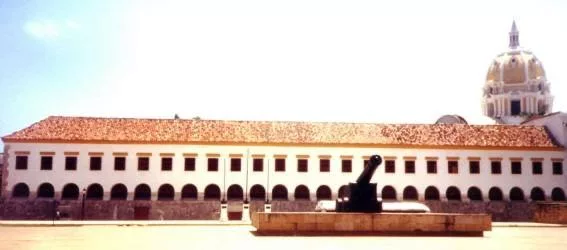
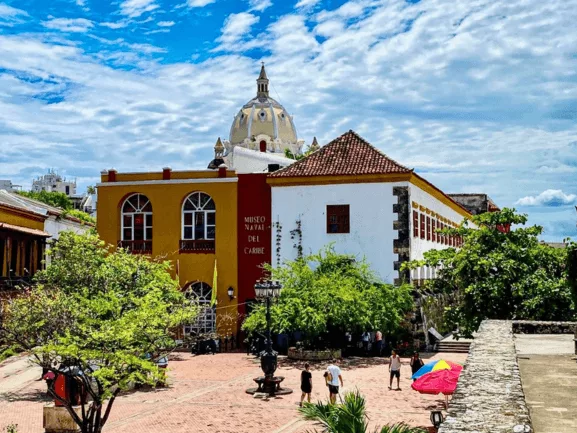
Located in the colonial building of the former College of the Society of Jesus in Cartagena de Indias, the museum brings together heritage, research, and education, and is closely linked to the Colombian Navy and the “Almirante Padilla” Naval Cadet School.
Un viaje por nuestra historia
Necesidad de un museo naval
Since the 1950s, there has been a deep desire within the National Navy to establish a museum to preserve the country’s maritime heritage. This desire was reflected in the works of renowned naval historians such as Rear Admiral (Ret.) Julio César Reyes Canal—in whose honor the museum’s library was named—and Rear Admiral Óscar Herrera Rebolledo, whose insistence on preserving historical memory inspired subsequent generations of admirals after his retirement in 1967.
Un primer intento
In 1970, Rear Admiral Eduardo Wills Olaya, then second-in-command of the National Navy, proposed the creation of the museum to Admiral Jaime Parra Ramírez, who entrusted the project to Rear Admiral Eduardo Meléndez Ramírez.
Rear Admiral Meléndez met with Cartagena residents to establish a nonprofit association. However, although the initial legal steps were taken, the initiative unfortunately did not move forward operationally due to a lack of a headquarters, funding, or collections, and remained inactive on paper.
Resurge el interés gracias al Galeón San José
In the early 1980s, reports of an alleged discovery of the San José galleon sparked great institutional enthusiasm for underwater archaeology. Anticipating an imminent salvage operation, the national government, the Commission on Shipwreck Antiquities, and the National Navy began preparing to receive and process the artifacts that were planned to be recovered. Amid this fervor, Dr. Mauricio Obregón Andreu—presidential delegate to the Commission and a renowned diplomat and historian—obtained in 1985 the endorsement of the OAS and CARIMOS for the creation of a Naval Museum with a scope encompassing the entire Caribbean..
Resurge el interés gracias al Galeón San José
In the early 1980s, reports of an alleged discovery of the San José galleon sparked great institutional enthusiasm for underwater archaeology. Anticipating an imminent salvage operation, the national government, the Commission on Shipwreck Antiquities, and the National Navy began preparing to receive and process the artifacts that were planned to be recovered. Amid this fervor, Dr. Mauricio Obregón Andreu—presidential delegate to the Commission and a renowned diplomat and historian—obtained in 1985 the endorsement of the OAS and CARIMOS for the creation of a Naval Museum with a scope encompassing the entire Caribbean.
Se materializa el sueño: La Fundación
The museum’s legal and operational establishment was solidified in 1988. Under the leadership of Dr. Mauricio Obregón, the Caribbean Naval Museum Foundation was established—a private, nonprofit entity with autonomous legal status, composed of civilian and military founders, and possessing its own assets and governing bodies. Since then, the Foundation has managed the museum continuously and successfully. THE FOUNDATION
Dr. Obregón was elected its first President and entrusted the directorship to Vice Admiral (Ret.) Eduardo Wills Olaya, who oversaw the colossal architectural restoration that brought the current museum building to life.
Se materializa el sueño: La Fundación
The museum’s legal and operational establishment was solidified in 1988. Under the leadership of Dr. Mauricio Obregón, the Caribbean Naval Museum Foundation was established—a private, nonprofit entity with autonomous legal status, composed of civilian and military founders, and possessing its own assets and governing bodies. Since then, the Foundation has managed the museum continuously and successfully. THE FOUNDATION
Dr. Obregón was elected its first President and entrusted the directorship to Vice Admiral (Ret.) Eduardo Wills Olaya, who oversaw the colossal architectural restoration that brought the current museum building to life.
Desarrollo hasta la fecha
Throughout its history, the museum has received support from individuals, companies, and its own resources generated by the Foundation. Its operations are continuously supported by the Colombian Navy and the “Almirante Padilla” Naval Cadet School, ensuring its establishment as a key institution for regional history.
Desarrollo hasta la fecha
Throughout its history, the museum has received support from individuals, companies, and its own resources generated by the Foundation. Its operations are continuously supported by the Colombian Navy and the “Almirante Padilla” Naval Cadet School, ensuring its establishment as a key institution for regional history.
What can you see at the Naval Museum today?
The Caribbean Naval Museum showcases the cultural and historical richness of Colombia’s maritime tradition, which developed in Cartagena de Indias. More than 400 historical artifacts, detailed models, and educational resources promote the protection of underwater cultural heritage and highlight the Navy’s role in national identity.
The exhibition is divided primarily into two large halls:
The Republican Hall: This hall tells the story of global navigation, Cartagena’s defenses against pirates and privateers (such as Sir Francis Drake), and displays artifacts from Spanish galleons recovered from the seabed. At the center of this hall stands a scale replica of the San José galleon, where visitors can learn about the tragic history of this flagship.
The Naval Gallery: This hall traces the evolution of the Colombian Navy from Independence (including the Naval Battle of Lake Maracaibo) to the present day. It features historical uniforms, scale models, and an interactive section dedicated to the Submarine Force and Naval Aviation.
The Building
The headquarters is an architectural gem consisting of two large wings (the Republican and the Colonial) separated by two beautiful colonial/republican courtyards. the building
Patio de Los Jesuitas: Home to the iconic Bells of Liberty.
Patio de San Carlos: Features a valuable collection of historic cannons, including “El Vigilante” (the cannon that saved Colombia) and an
Admiralty-type anchor.Due to their great historical, aesthetic, and cultural value, these courtyards provide an ideal setting not only for learning but also for hosting institutional, cultural, and social events.
Discover the history that runs through Cartagena
Discover Colombia’s naval heritage and learn about the history of an institution that has worked for decades to preserve the country’s maritime history.
Visit the Caribbean Naval Museum in Cartagena de Indias and experience history from the heart of the Historic District.